
Ecosystem Services
Recognizing and protecting the essential benefits that nature provides—clean air, clean water, biodiversity, and more.

Built Infrastructure
Promoting infrastructure systems designed to withstand and adapt to changing conditions.

Social Dynamics
Empowering local stakeholders through education, collaboration, and preparedness to lead resilience efforts.

Economic Activities
Supporting long-term strategies that promote environmental stewardship, innovation, and community well-being.

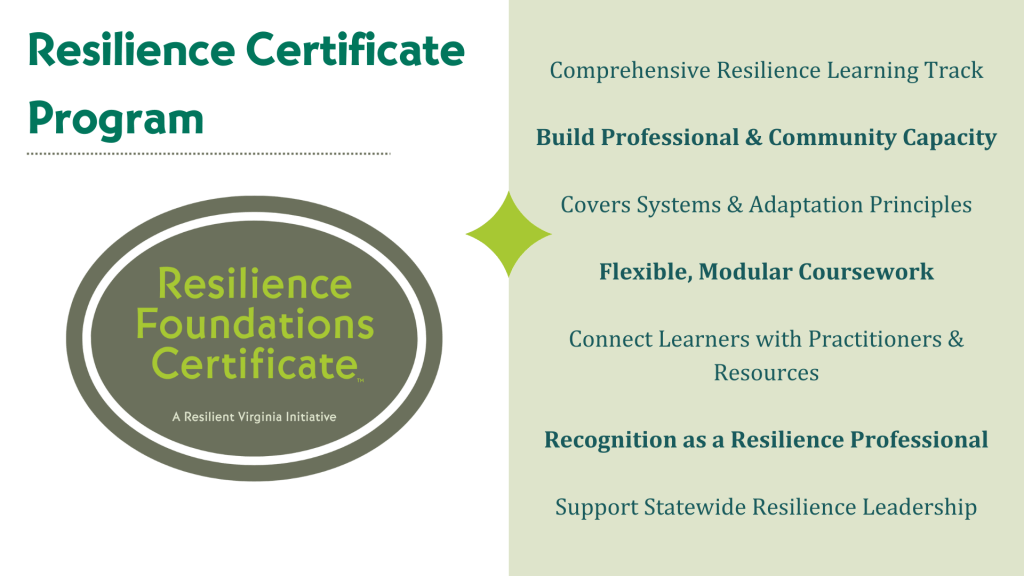
Graduates of the Resilience Foundations Certificate Program will emerge with the knowledge, skills, and leadership competencies needed to guide their organizations and communities toward a more sustainable and adaptable future. Participants will learn to:
Understand systems-level resilience
Explore how ecological, infrastructural, social, and economic systems interconnect and influence one another, and recognize how resilience in one area supports the stability and sustainability of the whole.
Analyze change, risk, and vulnerability
Gain tools to assess exposure to natural, social, and economic hazards, identify underlying drivers of risk and inequity, and use data-driven approaches to prioritize resilience investments.
Apply systems thinking to complex challenges
Learn to move beyond siloed approaches by designing solutions that consider feedback loops, interdependencies, and co-benefits across multiple systems.
Develop adaptation and mitigation strategies
Translate resilience principles into actionable plans that reduce vulnerability, strengthen infrastructure, and advance climate adaptation and greenhouse gas reduction goals.
Integrate equity into resilience planning
Ensure that strategies address the needs of all community members by embedding justice, inclusivity, and equitable access to resources and opportunities into resilience initiatives.
Facilitate collaboration and informed decision-making
Build skills for convening diverse stakeholders—from government, business, and nonprofits to community members—to co-create solutions and align resilience efforts across sectors.
Communicate effectively across audiences
Learn to translate technical concepts into accessible language, engage the public and decision-makers, and foster a shared understanding of resilience priorities and benefits.
Lead and manage change in complex systems
Strengthen leadership and management capacities to guide teams, organizations, and communities through uncertainty and transformation with vision and agility.
Design scalable, locally relevant strategies
Develop approaches that balance innovation and practicality, adapting best practices to the unique conditions and priorities of Virginia’s communities while supporting broader state and regional resilience goals.
Commit to lifelong learning and leadership
Cultivate an ongoing practice of reflection, professional development, and engagement with emerging resilience research, tools, and networks to remain effective in a rapidly changing world.

The Resilience Foundations Certificate Program is designed as a dynamic learning journey, delivered through a series of interconnected modules that progress from foundational understanding to applied leadership. Each module builds on the last, helping participants move from learning key concepts to leading systems-level change within their organizations and communities.
Variability and Change
Examine how natural, social, and economic systems evolve and interact over time. Participants will explore the drivers of variability—from climate dynamics to population shifts and technological innovation—and how these forces shape resilience challenges and opportunities.
Hazards and Impacts
Understand how change translates into risk across sectors and scales. This module explores the types of hazards (climate-related, economic, and social), their cascading effects, and how impacts are distributed across communities and systems.
Vulnerability
Identify the underlying factors—social, infrastructural, economic, and ecological—that influence a community’s ability to prepare for, withstand, and recover from disruption. Participants will assess vulnerability through data analysis and community perspectives to inform equitable resilience planning.
Risk
Develop the ability to measure and communicate risk by examining its three key dimensions: probability, consequence, and perception. Learners will gain strategies for risk assessment, visualization, and communication that support evidence-based decision-making.
Adaptation and Resilience
Differentiate between adaptation and resilience, and design strategies that strengthen both. Participants will explore case studies of effective adaptation, learning how to foster flexibility, redundancy, and innovation across systems.
Mitigation
Explore methods for preventing or minimizing the impacts of hazards before they occur. This module introduces practical approaches to emissions reduction, sustainable land use, and infrastructure design that enhance long-term community and environmental well-being.
Systems Thinking
Apply analytical frameworks and mapping tools to understand how issues are interconnected. Through exercises and simulations, participants will learn to identify leverage points where strategic interventions can generate wide-reaching benefits.
Equitable Future
Embed justice and inclusion in every aspect of resilience work. Participants will learn to recognize systemic inequities, engage underrepresented voices, and design resilience strategies that ensure fair access to opportunities and resources.
Change Management
Build leadership capacity to guide organizations and communities through uncertainty and transformation. This module focuses on practical tools for fostering adaptability, aligning teams around shared goals, and sustaining momentum for long-term change.
Decision Making
Examine how governance structures, policy frameworks, and institutional cultures shape resilience choices. Participants will practice methods for integrating diverse perspectives, balancing short- and long-term priorities, and making transparent, informed decisions.
Communication and Convening
Strengthen skills for building trust and shared purpose among diverse audiences. Participants will practice framing messages, facilitating dialogue, and convening cross-sector partnerships that advance collective resilience goals.
Dynamic Module
Customized learning sessions can be designed around participants’ emerging needs and regional priorities.